
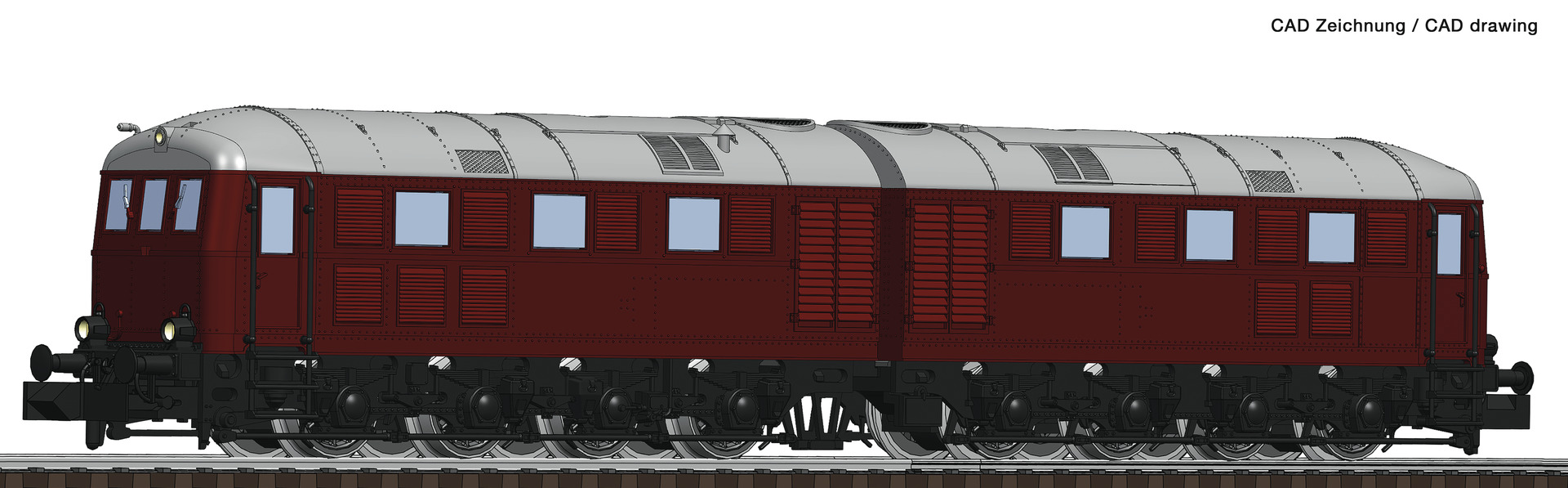
Diesel electric double locomotive 288 002-9
2,749 SEK
In 1941 and 1942, a total of four Type D 311 double locomotives were put into service
by the Deutsche Wehrmacht. The D 311.01 a/b, also known as 'Walli', was used on the
Crimean peninsula. Along with its sister engine, the D 311.02 a/b 'Dora', it manoeuvred
the largest railroad gun ever built. The locomotives D 311.03 and 04 were intended for
use with the 'Schwerer Gustav 2' gun, and were probably put into use in the West of
Germany. The fifth and sixth double locomotives were ordered from Krupp, but ultimately
could not be built due to war events.
The engines were equipped with electric power transmission. For each half-unit, a DC
generator directly powered by the diesel engine supplied the electric traction motors on
each of the four wheelsets with power. Accordingly, the axle arrangement designation was
Do+Do. The controls of both locomotive halves were electrically coupled, and were operated
from the respective preceding driver’s cab. The machine weighed 147 tonnes in total.
Its top speed was 75 km/h. In the 'Dora' firing position, the locomotives also supplied the
electrical power for operation of the gun.
At the end of the war, the double locomotive D 311.03 a/b was located near to Freilassing,
and was put into operation once more after an overhaul in 1948-49 at Krauss-Maffei
as the V 188 001 a/b for the 'Reichsbahn West'. The D 311.04 a/b was found in the
Netherlands, and was purchased at the end of 1949 by the still-young Deutsche Bundesbahn.
This engine was then handed over to the company after renovation in 1951 as the
V 188 002 a/b. The D 311.02 a/b, which had ended up at Krupp in Essen, was merely
used to provide spare parts. The two renovated class V 188 engines proved their worth
in heavy freight train and shunting services, mainly on the Spessart-Rampe. At the end of
the 1950s, the vehicles were equipped with Maybach engines, such as those used in the
V 200.0 and in the VT 08.
After damage to the generator, the V 188 001 was phased out in 1968. The V 188
002, later the 288 002, remained in operation in the Franconian region until 1972. Both
machines were scrapped in 1973.
Description
Article no.: F01.725100
- BrandFleischmann
- CompanyDB
- Digital/analogueDC analouge
- EpocheIV
- Mfg item no725100
- Scale1:160 (N)
- Secure payment by card
- Send e-mail or chat with us if we are online
- We ship world wide
We reserve the right for typos and errors in article descriptions
Description
Article no.: F01.725100